
Nuvectis Pharma, Inc. NXP900 in combination with Osimertinib (SRC family kinases (SFK) inhibitor (NXP900) combined with EGFR inhibitor (Osimertinib)) EGFR-mutated NSCLC Phase 1b

Program Detail:
Sponsor: Nuvectis Pharma, Inc.
Intervention: NXP900 in combination with Osimertinib (Orally administered inhibitor of SRC family kinases (SFK))
Indication: EGFR Mutation Positive Non-small Cell Lung Cancer
Phase: Phase 1b
Trial Design: single_arm, n=18, Primary endpoint: Number of patients with treatment related adverse events and/or clinical laboratory abnormalities
ID: NCT07315113
Report type: Program Assessment
Analysis date: July 29, 2026
Executive Summary
NXP900 — a first-in-class selective SRC family kinase (SFK) inhibitor — is being evaluated in a Phase 1b combination study with osimertinib in post-osimertinib EGFR-mutated NSCLC, a setting with strong preclinical rationale but no human efficacy data and a rapidly crowding competitive landscape. The program’s value hinges entirely on whether the preliminary Phase 1b readout expected in summer 2026 demonstrates sufficient safety and early efficacy signal to justify advancement to Phase 2, as the biological plausibility rests on preclinical synergy data alone [1]. The primary risk is that the post-osimertinib treatment landscape will be saturated with at least five approved agents by the time NXP900 could reach the market (~2033), compressing both the addressable population and pricing ceiling.
The base-case rNPV of $2.7M reflects present value as of the July 29, 2026 analysis date, with underlying revenue not commencing until the projected ~2033 approval. This figure incorporates a 4.96% probability of approval and only five years of commercial runway under NCE exclusivity. The PoA of 4.96% sits below the 5% threshold more typical of clinical-stage oncology programs, reflecting a Phase 1 FIH oncology base rate adjusted (+) for EGFR biomarker selection and (−) for a novel, clinically unvalidated mechanism of action. The novel-MoA adjustment is the dominant downward driver and is only partially offset by biomarker selection; this is consistent with the absence of any approved SFK inhibitor in NSCLC and the lack of human efficacy data. The novel-MoA adjustment is a modeled assumption rather than an empirically derived benchmark and should be treated as indicative rather than precise; the absence of a validated calibration dataset for novel-MoA oncology programs means the precise magnitude is inherently uncertain. On a standalone basis, the program’s economics are marginal. However, the low remaining trial cost (~$5.2M, reflecting biomarker-selection and DLT-monitoring adjustments to the base per-patient benchmark plus screening overage and overhead) is modest relative to the potential partnership upside. Evidence of active partnering interest in EGFR NSCLC assets — including recent licensing and M&A transactions in the indication [2][3] — further supports the view that the cost of generating the next value-inflecting data point is small compared to the option value a partner may assign. Whether continued development is warranted is a sponsor capital-allocation decision; this report does not constitute a recommendation regarding the sponsor’s stock or the program’s continuation.
Declared Assumptions
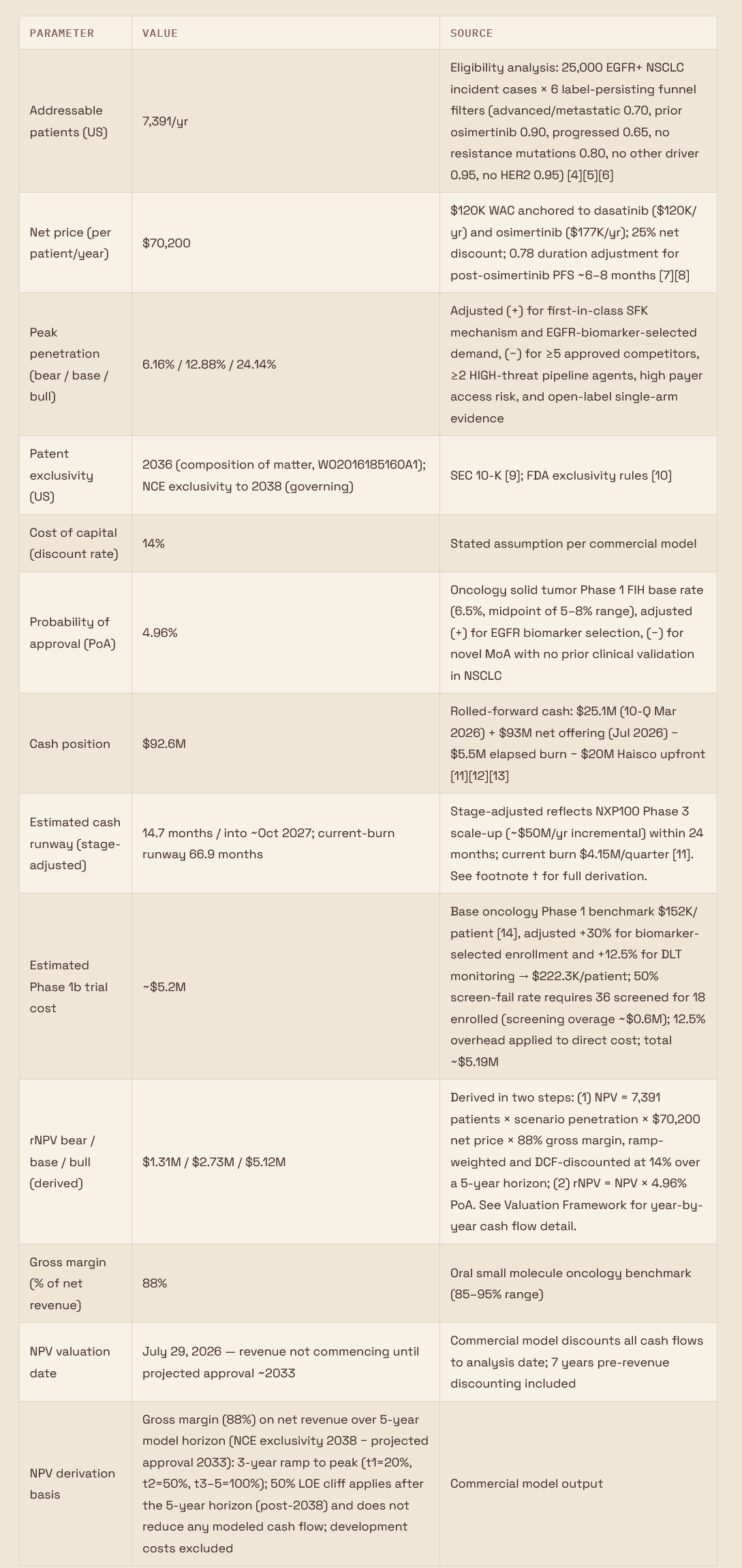
Program Scorecard
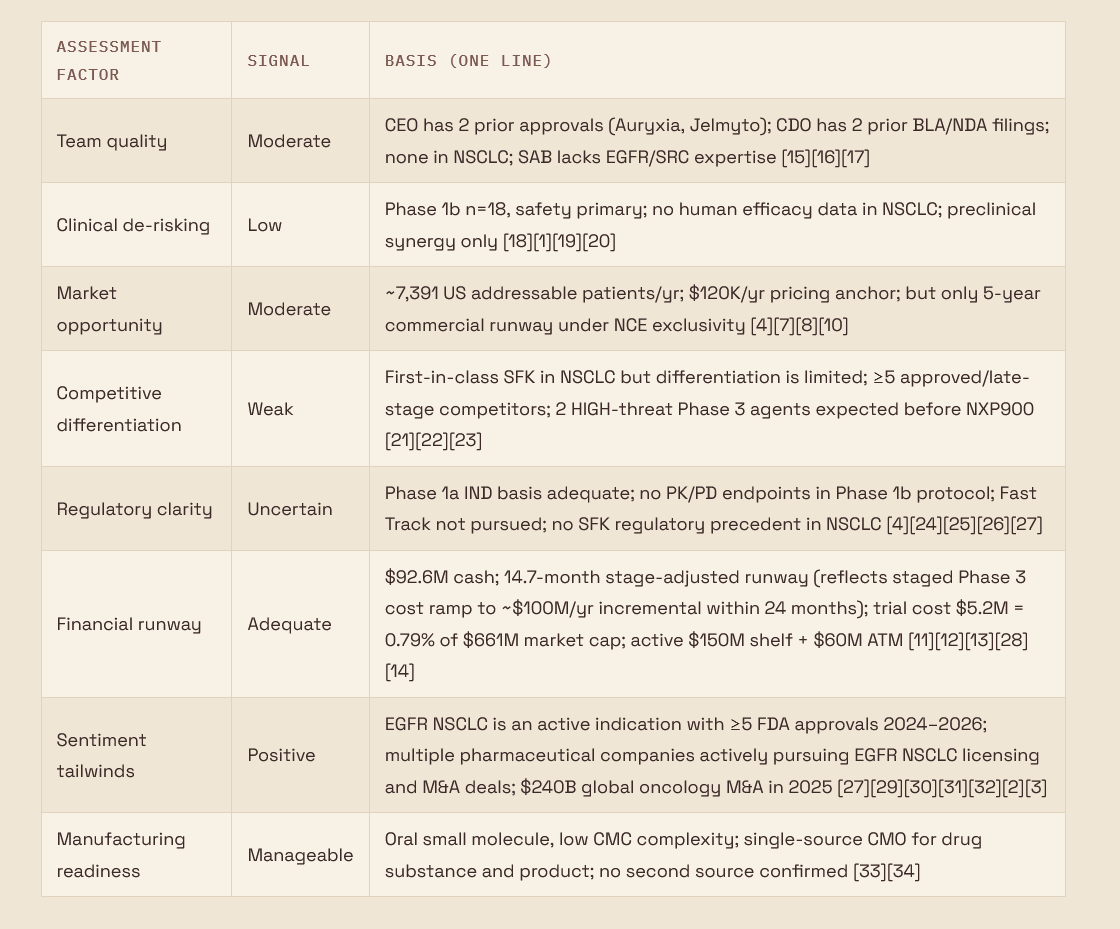
Risk-Adjusted Program Value:
Probability of Approval (PoA): 4.96% — reflecting a Phase 1 FIH oncology base rate adjusted (+) for EGFR biomarker selection and (−) for a novel unvalidated mechanism of action; below 5% but consistent with no approved SFK inhibitor in NSCLC and no human efficacy data; the novel-MoA adjustment is a modeled assumption, not an empirically calibrated benchmark, and its precise magnitude is inherently uncertain
rNPV base case: $2.73M — reflects present value as of July 29, 2026; underlying revenue does not begin until projected ~2033 approval; US-only, current-label scope
Peak revenue base case: $66.8M in year ~3 post-approval — 12.88% penetration of ~7,391 US patients at $70,200 net/year
Near-Term Catalysts
Catalyst 1: Preliminary Phase 1b safety and efficacy readout
Expected timing: Summer 2026 (per Nuvectis Q1 2026 earnings call) [11]
Positive outcome: Acceptable safety profile with no dose-limiting toxicities from the NXP900+osimertinib combination, plus early efficacy signal (ORR/DCR) suggesting SRC pathway inhibition is clinically active in post-osimertinib patients — this would support advancement to a formal Phase 2 trial and an EOP1 meeting with FDA
Negative outcome: Unacceptable overlapping toxicity (cardiac, pulmonary, or GI) requiring dose reduction or discontinuation, or no early efficacy signal above the post-osimertinib benchmark — this would call into question the combination’s therapeutic index and potentially halt the program
Probability of positive outcome: 45% — Phase 1a single-agent safety was acceptable (no DLT up to 250mg), but no human combination data exists and overlapping toxicity with osimertinib is a material concern [18][35][36]
Program impact: Binary/Pivotal
Catalyst 2: Fast Track designation decision
Expected timing: Within 6–9 months of filing (if pursued)
Positive outcome: FDA grants Fast Track designation for NXP900+osimertinib in osimertinib-resistant EGFR-mutated NSCLC, enabling rolling submission and more frequent FDA interactions — criteria appear met (serious condition, unmet need) [27]
Negative outcome: FDA declines Fast Track, citing the expanding post-osimertinib treatment landscape as reducing unmet need — this would slow the regulatory path and signal FDA skepticism about the mechanism’s differentiation
Probability of positive outcome: 60% — Fast Track criteria for serious condition with unmet need appear met, though the bar may rise as approved competitors accumulate
Program impact: De-risking
Catalyst 3: EOP1 meeting and Phase 2 design finalization
Expected timing: ~6–9 months after Phase 1b readout (if positive), estimated H1 2027
Positive outcome: FDA agrees on Phase 2 design, endpoint strategy (ORR/PFS), and biomarker-enrichment approach; alignment on go/no-go criteria for registrational Phase 3
Negative outcome: FDA requires additional PK/PD data, a validated companion diagnostic for resistance-mutation exclusion, or a larger safety database before Phase 2 — this would extend timelines and increase costs
Probability of positive outcome: 50% — Phase 1a data package is solid, but the absence of PK/PD endpoints in the Phase 1b protocol and lack of validated CDx create regulatory friction [24][4]
Program impact: Binary/Pivotal
Catalyst 4: SAFFRON Phase 3 topline data (savolitinib+osimertinib)
Expected timing: H1 2026 (originally projected); as of the July 29, 2026 analysis date, the H1 2026 window has closed but no public release of SAFFRON topline results has been confirmed — the data may be pending presentation at a medical congress, representing a modest delay relative to the original expectation [23]
Positive outcome: SAFFRON meets its primary PFS endpoint, adding a third or fourth approved competitor in post-osimertinib EGFR+ NSCLC before NXP900 reaches Phase 2 — this further fragments the market and raises the efficacy benchmark NXP900 must exceed
Negative outcome: SAFFRON fails to meet its primary endpoint, reducing competitive pressure and potentially validating the need for alternative resistance-pathway mechanisms like SFK inhibition
Probability of positive outcome: 70% — SACHI Phase 3 was positive (PFS 8.2 vs 4.5 months); SAFFRON uses the same combination in a global population [23]
Program impact: Setback (for NXP900, as a competitor’s positive readout increases competitive pressure)
Market Opportunity
The addressable US population for NXP900+osimertinib is approximately 7,391 patients per year, derived from ~25,000 annual EGFR+ NSCLC incident cases filtered through six label-persisting eligibility steps: advanced/metastatic stage (70%), prior osimertinib receipt (90%), annual progression flow (65%), exclusion of known osimertinib-resistance mutations such as C797S (80%), no co-occurring oncogenic drivers (95%), and no HER2 overexpression (95%) [4][5][6]. The most sensitive assumption is the progressed-on-osimertinib annual flow rate of 65%; using 80% would raise the addressable population by ~23% to ~9,100.
Pricing is anchored to osimertinib (~$177K/year WAC) [7] and dasatinib (~$120K/year WAC) [8], with NXP900 modeled as a $120K/year WAC combination add-on. After adjustments for net price discount and treatment duration reflecting the ~6–8 month median PFS in the post-osimertinib setting, the net annual revenue per patient is $70,200. Peak revenue ranges from $32.0M (bear, 6.16% penetration) to $66.8M (base, 12.88%) to $125.3M (bull, 24.14%), with peak estimated at year 3 post-approval. These figures are US-only under the current trial eligibility label (post-osimertinib EGFR+ NSCLC without known resistance mutations).
Two independent upside levers exist beyond the US-only base case. First, label/patient-pool expansion: dropping the C797S/resistance-mutation exclusion would expand the eligible population by ~25%, as the current 0.80 filter excludes ~20% of post-osimertinib patients; earlier-line expansion (1L combination with osimertinib) would require a separate pivotal trial and is not reflected in this figure. Second, ex-US revenue: EU5 + Japan markets represent a patient volume multiplier of 3.35× the US (reflecting higher EGFR prevalence in Japan ~36% vs US ~15%) [37], with an ex-US net price ratio of 0.50; applying the same penetration as the US base case yields an ex-US revenue block equivalent to 167.5% of the US base. This ex-US figure is a ceiling under same-rate assumptions — ex-US pricing and penetration are typically lower than the US due to reference pricing systems, later launch timing, and single-payer negotiations. Ex-US development is not currently planned. These two levers are independent and multiply rather than add: combined, total revenue potential = US base × 1.25 × 2.675.
The competitive landscape is the dominant commercial risk. The post-osimertinib standard of care already includes amivantamab+chemotherapy (MARIPOSA-2) [38], datopotamab deruxtecan (Datroway, accelerated approval June 2025) [39], and platinum chemotherapy ± osimertinib continuation. Two HIGH-threat pipeline agents are expected to reach approval before NXP900: sacituzumab tirumotecan (sac-TMT), which demonstrated Phase 3 PFS benefit (8.3 vs 4.3 months) and OS benefit with Breakthrough Therapy designation in December 2024 [21][22], and savolitinib+osimertinib, whose Phase 3 SACHI trial was positive (PFS 8.2 vs 4.5 months) with SAFFRON global topline data originally expected H1 2026 but not yet publicly released as of the July 29, 2026 analysis date [23]. Additional pipeline threats include firmonertinib (Phase 3, ArriVent) [40] and silevertinib (Phase 2, Black Diamond, targeting C797S directly) [41]. By NXP900’s projected approval (~2033), the post-osimertinib landscape is expected to be highly fragmented with biomarker-stratified treatment selection, and osimertinib’s earliest US generic entry (~July 2032) [42] may compress the combination pricing ceiling. NXP900’s first-in-class SFK mechanism could differentiate if efficacy is demonstrated, but current evidence is insufficient to project competitive positioning against agents with established Phase 3 efficacy benchmarks.
Management Team Assessment
CEO Ron Bentsur led two prior drug approvals as CEO — Auryxia (Keryx Biopharmaceuticals, ~2014) and Jelmyto (UroGen Pharma, ~2019) — and Chief Development Officer Shay Shemesh led the BLA for Elzonris (Stemline) and late-stage trials for Auryxia [15][16]. This provides credible end-to-end drug development execution experience, though none of these approvals were in NSCLC or EGFR-mutant disease. The board is 80% independent (4 of 5 directors) and includes a director who served through the Caplyta approval at Intra-Cellular Therapeutics [43][44]. No insider selling has occurred in the most recent 6-month window; the CEO and a 10% holder made open-market purchases [45].
Several governance and team-fit concerns temper this assessment, however. The combined CEO/Chairman role reduces board independence from management. The Scientific Advisory Board comprises three members focused on gynecologic and precision oncology, with no EGFR-mutant NSCLC or SRC kinase expertise [17]. The organization is very small (13 employees), creating limited operational redundancy. Three equity raises — the February 2022 IPO ($16M gross proceeds) [46], a February 2025 follow-on ($15.5M gross) [47], and the June 2026 offering ($100M gross) [48], totaling ~$131.5M — have produced estimated dilution exceeding 40% with no inbound licensing income offset, though the recent $100M raise at $20/share — 4× the prior follow-on price — reflects investor appetite at a higher price point [48][47][49][46]. The discontinuation of the NXP800 ovarian cancer program in July 2025 demonstrates disciplined capital allocation but also concentrates pipeline risk on NXP900 [50]. Overall team quality is rated moderate: experienced in drug development execution but lacking indication-specific expertise for this program’s competitive and scientific complexity.
Key Program Risks
Risk 1: No human efficacy data in NSCLC
Category: Clinical
Probability: High
Program impact: Program-ending
Mitigation: Phase 1b readout (summer 2026) will provide first human efficacy signal; preclinical synergy data and >90% SRC inhibition in Phase 1a patient samples support biological activity [18][19][20]
Basis: All efficacy evidence is preclinical (in vitro/in vivo synergy with osimertinib); Phase 1a in advanced solid tumors reported no NSCLC-specific ORR; the only class analogue (dasatinib+osimertinib) showed 80% ORR but in TKI-naïve, not post-resistance, patients [1][19][51]
Risk 2: Competitive landscape saturation before approval
Category: Commercial
Probability: High
Program impact: Major setback
Mitigation: First-in-class SFK mechanism may address bypass-pathway resistance not covered by existing agents; biomarker-stratified positioning could carve a niche
Basis: ≥5 approved/late-stage agents in post-osimertinib EGFR+ NSCLC; 2 HIGH-threat Phase 3-positive agents (sac-TMT, savolitinib+osimertinib) expected approval ~2027, well before NXP900’s ~2033 projected approval; market fragmentation and payer access risk are high [38][39][21][22][23]
Risk 3: Phase 1b protocol omits PK and PD endpoints
Category: Regulatory
Probability: Medium
Program impact: Major setback
Mitigation: Phase 1a established PK profile and >90% SRC inhibition; a dedicated DDI study was completed showing no CYP3A induction; protocol amendments could add PK/PD sampling
Basis: Combination study with osimertinib (CYP3A4 substrate) requires PK assessment for drug-drug interaction; SRC target engagement in combination setting is unconfirmed; no PD endpoint listed in the Phase 1b protocol [4][36]
Risk 4: Overlapping toxicity without dose modification rules
Category: Clinical
Probability: Medium
Program impact: Major setback
Mitigation: NXP900 is >1000-fold selective over ABL, avoiding dasatinib-class pleural effusion and QT risks; Phase 1a showed no DLT up to 250mg; no CYP3A induction reduces DDI risk
Basis: Osimertinib carries QT prolongation and ILD risk (1–3.8%); NXP900 Phase 1a showed dyspnea signal; overlapping GI toxicity (diarrhea, nausea) from both agents may be additive; no formal DLT definition or dose modification schema specified in the available Phase 1b protocol [52][4][53][54][18][35][36][55][56]
Valuation Framework
The risk-adjusted NPV ranges from $1.31M (bear) to $2.73M (base) to $5.12M (bull), all reflecting a single 4.96% probability of approval applied to scenario-specific NPVs. The base-case NPV of $55.13M is driven by 88% gross margin on net revenue over a 5-year model horizon (NCE exclusivity from projected 2033 approval to 2038), with a 3-year ramp to peak. The 50% LOE revenue cliff applies after the 5-year model horizon (i.e., post-2038) and does not reduce any cash flow within the modeled period; the $55.13M NPV reflects only the five years of NCE exclusivity from 2033 to 2038. All cash flows are discounted at 14% to the July 29, 2026 analysis date, with 7 years of pre-revenue discounting embedded.
The year-by-year base-case gross profit cash flows and their present values are:
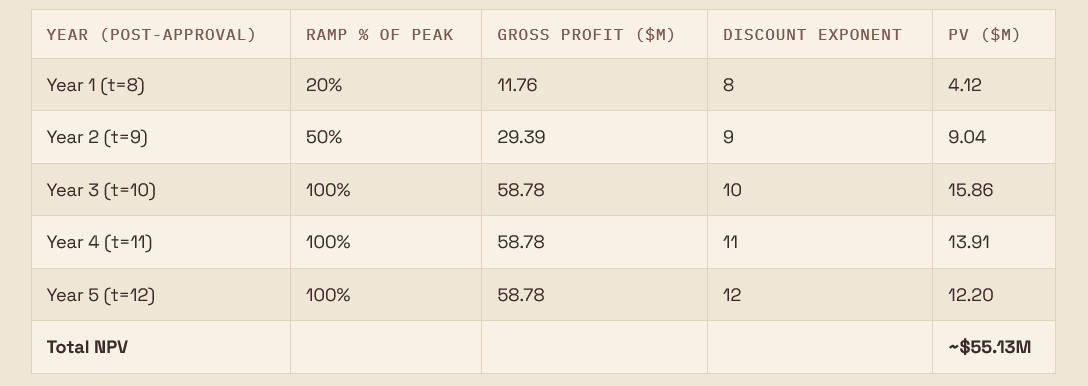
Gross profit = peak revenue ($66.8M) × ramp % × 88% gross margin. Discount exponents reflect 7 years of pre-revenue discounting (analysis date 2026 to projected approval ~2033) plus the post-approval year index. The 50% LOE cliff would reduce revenue by half beginning post-year-5 (after 2038), but this period falls outside the 5-year model horizon and is not valued in the NPV.
The rNPV is highly sensitive to three assumptions:
PoA (4.96%): This figure sits below the 5% threshold more typical of clinical-stage oncology programs, reflecting a Phase 1 FIH oncology base rate adjusted (−) for a novel, clinically unvalidated mechanism (no approved SFK inhibitor in NSCLC) and only partially offset by EGFR biomarker selection. The novel-MoA adjustment is the dominant downward driver, and the sub-5% result reflects the absence of any human efficacy data for SFK inhibition in NSCLC. This adjustment is a modeled assumption rather than an empirically calibrated benchmark; while it is directionally consistent with the lack of clinical validation for SFK inhibition in this indication, its precise magnitude is uncertain and should be treated as indicative. The absence of a validated calibration dataset for novel-MoA oncology programs means the precise multiplier is inherently uncertain. A 2-percentage-point increase to ~7% would raise rNPV by ~41% to ~$3.9M; doubling rNPV to ~$5.5M would require PoA near ~10%. Both scenarios would demand human efficacy validation that does not yet exist.
Peak penetration (12.88% base): In a market with ≥5 approved competitors, achieving even 13% share of the resistance-mutation-negative subset is optimistic; the bear case at 6.16% may be more realistic.
Commercial runway: Only 5 years of NCE exclusivity (2033–2038) limits the revenue window, and osimertinib generic entry (~2032) may compress the combination pricing ceiling before NXP900 even launches.
The partnership/licensing value is estimated at ~$100M, materially exceeding the standalone rNPV of $2.73M. This gap is reconcilable: the $100M figure reflects a partner’s valuation of the first-in-class SFK mechanism in an active indication with significant deal-making. Multiple pharmaceutical companies are pursuing EGFR NSCLC licensing and M&A transactions, including BMS’s collaboration with SystImmune for an EGFRxHER3 bispecific ADC and AbbVie’s licensing of a PD1xVEGF bispecific, both at substantial valuations — though these involved more clinically advanced assets [2][3]. A buyer in such a transaction assigns option value to a novel resistance-pathway approach that may address patients not served by existing biomarker-stratified therapies. The remaining cost to the next value-inflecting readout is only ~$5.2M (the Phase 1b trial cost) [28][14] — reflecting a per-patient oncology Phase 1 benchmark adjusted (+) for biomarker-selected enrollment and DLT monitoring, plus screening overage and overhead. This cost is small relative to the potential partnership value, which is one reason a partner or acquirer could in principle justify paying above the standalone rNPV: the incremental cost to determine whether the mechanism works is modest. However, the $100M partnership estimate is itself a modeled assumption and depends on a positive Phase 1b readout; without human efficacy data, a partner’s willingness to pay at this level remains speculative. The program’s value steps up most significantly at the Phase 1b preliminary readout (summer 2026): a positive safety and efficacy signal could support a partnership or licensing deal in the $50–100M+ range, while a negative readout would likely terminate the program. This analysis is an assessment of program-level economics and does not constitute a recommendation regarding Nuvectis Pharma’s stock.
Due Diligence Checklist
Confirm Phase 1b protocol PK/PD endpoints — Request the full protocol from Nuvectis or ClinicalTrials.gov to verify whether PK sampling and SRC target engagement biomarkers are included despite not appearing in the available protocol information; their absence would be a material regulatory gap before EOP1 [4]
Obtain Phase 1b preliminary readout details — Monitor Nuvectis’s summer 2026 data presentation for specific safety results (DLT incidence, dose modifications), ORR, and DCR in the combination setting; this is the single most value-determining event for the program [11]
Verify Fast Track designation status — Check FDA’s Fast Track designation database or contact Nuvectis investor relations to confirm whether Fast Track has been filed or granted for NXP900+osimertinib; the indication appears to meet criteria but no filing is referenced [27]
Confirm second-source CMO qualification timeline — Request Nuvectis’s manufacturing strategy disclosures or SEC filings for plans to qualify a second-source CMO for NXP900 drug substance and drug product before Phase 2; single-source dependency is a supply disruption risk [34]
Assess SAFFRON topline data impact — Monitor for public release of SAFFRON (NCT05261399) topline results for savolitinib+osimertinib; the original H1 2026 expectation has passed without confirmed public disclosure as of the July 29, 2026 analysis date, and a positive readout whenever released would add another approved competitor and raise the efficacy benchmark, while a negative result would reduce competitive pressure [23]
Validate NXP100 Phase 3 financing plan — Review Nuvectis’s most recent SEC filings and investor presentations for dedicated financing for the NXP100 Phase 3 ex-China trial (~$50M/yr, anticipated to ramp to ~$100M/yr total incremental within 24 months), as this commitment reduces stage-adjusted runway to ~14.7 months (versus 16.7 months at constant burn without further escalation) and may require additional capital raises [11][57]
Key Sources
[1] NXP900 / Nuvectis Pharma — LARVOL DELTA pipeline tracker (AACR 2025, AACR 2026 data). https://delta.larvol.com/Products/?ProductId=fb66bd23-f7f8-4129-91a2-768ad1f03f9e.
[2] Beyond PD-1: The drugs reshaping cancer treatment at ASCO 2026. https://www.drugdiscoverytrends.com/beyond-pd-1-the-drugs-reshaping-cancer-treatment-at-asco-2026/.
[3] EpiBiologics raises $107M for its protein-degrading cancer drug. https://www.biopharmadive.com/news/epibiologics-series-b-targeted-protein-degradation-egfr/808984/.
[4] NCT07315113: Study of NXP900 With Osimertinib in Subjects With Advanced, EGFR-Mutated NSCLC. Nuvectis Pharma, Inc.. Phase 1. Status: RECRUITING.
[5] Cancer Stat Facts: Lung and Bronchus Cancer - SEER. https://seer.cancer.gov/statfacts/html/lungb.html.
[6] EGFR and Lung Cancer - American Lung Association. https://www.lung.org/lung-health-diseases/lung-disease-lookup/lung-cancer/symptoms-diagnosis/biomarker-testing/egfr.
[7] Prime Therapeutics Study: Tagrisso WAC $177,152/year. https://www.prnewswire.com/news-releases/prime-therapeutics-study-finds-tagrisso-new-first-line-lung-cancer-treatment-drives-ten-fold-use-4-million-cost-increase-300945574.html.
[8] Dasatinib Drug Price — DrugPatentWatch (North America ~$120K/yr). https://www.drugpatentwatch.com/p/drug-price/drugname/DASATINIB.
[9] Nuvectis Pharma, Inc., 10-K filed 2026-02-11, accession 0001104659-26-013044. https://www.sec.gov/Archives/edgar/data/1875558/000110465926013044/tmb-20251231x10k.htm.
[10] FDA FAQ: Patents and Exclusivity (NCE 5yr, ODE 7yr). https://www.fda.gov/drugs/development-approval-process-drugs/frequently-asked-questions-patents-and-exclusivity.
[11] Nuvectis Pharma, Inc., 10-Q filed 2026-05-05, accession 0001104659-26-055318. https://www.sec.gov/Archives/edgar/data/1875558/0001104659-26-055318/tmb-20260331x10q.htm.
[12] Nuvectis Pharma, Inc., 8-K filed 2026-06-30, accession 0001104659-26-079360. https://www.sec.gov/Archives/edgar/data/1875558/0001104659-26-079360/tm2619346d1_8k.htm.
[13] Nuvectis Pharma, Inc., 8-K filed 2026-06-23, accession 0001104659-26-076624. https://www.sec.gov/Archives/edgar/data/1875558/0001104659-26-076624/tm2618439d1_8k.htm.
[14] Phase-by-Phase Clinical Trial Costs Guide (oncology Phase 1 $152K/patient). https://prorelixresearch.com/phase-by-phase-clinical-trial-costs-guide/.
[15] Ron Bentsur Executive Bio — Equilar (sourced from Nuvectis DEF 14A). https://people.equilar.com/bio/person/ron-bentsur-nuvectis-pharma-inc/162101.
[16] Nuvectis Pharma Executive Bios — Equilar (Poradosu and Shemesh backgrounds). https://people.equilar.com/bio/org/nuvectis-pharma-inc/9593222.
[17] Nuvectis Pharma Announces Formation of Scientific Advisory Board (Sept 28, 2022). https://finance.yahoo.com/news/nuvectis-pharma-announces-formation-scientific-120000685.html.
[18] First in human phase 1 trial of the SRC family kinase inhibitor NXP900 in patients with advanced solid tumors (AACR 2025, CT153). https://aacrjournals.org/cancerres/article/85/8_Supplement/2/CT153/761540/Abstract-CT153-First-in-human-phase-1-trial-of-the.
[19] Nuvectis Pharma NXP900 data at 2025 AACR Meeting — first-in-human Phase 1 results. https://trial.medpath.com/news/nuvectis-pharma-to-present-promising-nxp900-data-at-2025-aacr-meeting.
[20] Nuvectis Pharma NXP900 poster highlights: >90% SRC inhibition in patient samples (AACR 2025). https://firstwordpharma.com/story/5955180.
[21] Sac-TMT Extends OS in Pretreated EGFR-Mutated NSCLC. https://www.onclive.com/view/sac-tmt-extends-os-in-pretreated-egfr-mutated-nsclc.
[22] Sacituzumab tirumotecan improves PFS and OS in EGFR TKI-resistant NSCLC (OptiTROP-Lung04). https://ecancer.org/en/video/12533-sacituzumab-tirumotecan-improves-progression-free-and-overall-survival-in-egfr-tki-resistant-nsclc.
[23] Trial Assessing Savolitinib/Osimertinib in NSCLC Completes Enrollment (SAFFRON, Nov 2025). https://www.cancernetwork.com/view/trial-assessing-savolitinib-osimertinib-in-nsclc-completes-enrollment.
[24] Nuvectis Pharma Provides Poster Presentation Highlights for NXP900 from the 2025 AACR Meeting. https://www.biospace.com/press-releases/nuvectis-pharma-provides-poster-presentation-highlights-for-nxp900-from-the-2025-aacr-meeting.
[25] Sprycel (dasatinib) FDA Approval History. https://www.drugs.com/history/sprycel.html.
[26] FDA approves Pfizer’s Bosulif (bosutinib) for newly-diagnosed Ph+ CML. https://cancerletter.com/drugs-and-targets/20180105_10c/.
[27] A remarkable year for NSCLC: Seven new FDA approvals in 2025 across biomarker-driven targeted therapies. https://pmc.ncbi.nlm.nih.gov/articles/PMC12873738/.
[28] NVCT Stock Price Quote & News - Nuvectis Pharma (market cap $661M, July 29 2026). https://robinhood.com/us/en/stocks/NVCT/.
[29] Datopotamab Deruxtecan in NSCLC: TROP2-Directed ADC Therapy Arrives With an EGFR-Specific Approval. https://oncodaily.com/oncolibrary/lung-oncology/datopotamab-deruxtecannsclc.
[30] FDA Accepts BLA for Ivonescimab Regimen in Pretreated EGFR-Mutated NSCLC. https://www.cancernetwork.com/view/fda-accepts-bla-for-ivonescimab-regimen-in-pretreated-egfr-mutated-nsclc.
[31] FDA Approves Monthly Subcutaneous Amivantamab for EGFR+ NSCLC. https://www.targetedonc.com/view/in-a-first-fda-approves-monthly-subcutaneous-amivantamab-for-egfr-nsclc.
[32] Sunvozertinib Shows Superior Efficacy vs Chemo in Frontline Advanced EGFR Exon 20+ NSCLC. https://www.onclive.com/view/sunvozertinib-shows-superior-efficacy-vs-chemo-in-frontline-advanced-egfr-exon-20-nsclc.
[33] Nuvectis — Innovative precision medicine for the treatment of serious conditions of unmet need in oncology. https://nuvectis.com/.
[34] Nuvectis Pharma 10-Q September 30, 2025 — single CMO for NXP900 drug substance and drug product. https://www.sec.gov/Archives/edgar/data/1875558/000110465925105939/tmb-20250930x10q.htm.
[35] Nuvectis Pharma Provides Poster Presentation Highlights for NXP900 from the 2025 AACR Meeting (April 29, 2025). https://www.globenewswire.com/news-release/2025/04/29/3070800/0/en/nuvectis-pharma-provides-poster-presentation-highlights-for-nxp900-from-the-2025-aacr-meeting.html.
[36] Nuvectis Pharma Provides Poster Presentation Highlights for NXP900 from the 2025 AACR-NCI-EORTC Conference (Oct 27, 2025). https://finance.yahoo.com/news/nuvectis-pharma-provides-poster-presentation-120000412.html.
[37] Updates in Management of EGFR-Mutated NSCLC (Europe 14.1%, Japan 36-40% EGFR prevalence). https://link.springer.com/article/10.1007/s11912-026-01751-0.
[38] FDA approves lazertinib with amivantamab-vmjw for non-small lung cancer (Aug 19, 2024). https://www.fda.gov/drugs/resources-information-approved-drugs/fda-approves-lazertinib-amivantamab-vmjw-non-small-lung-cancer.
[39] FDA grants accelerated approval to datopotamab deruxtecan-dlnk for EGFR-mutated NSCLC (Jun 23, 2025). https://www.fda.gov/drugs/resources-information-approved-drugs/fda-grants-accelerated-approval-datopotamab-deruxtecan-dlnk-egfr-mutated-non-small-cell-lung-cancer.
[40] firmonertinib (ArriVent BioPharma, Inc.), PHASE3, mechanism: oral, highly brain-penetrant, mutation-selective epidermal growth factor receptor (EGFR) tyrosine kinase inhibitor. [DB: arrivent-biopharma-inc--firmonertinib] Sources: https://synapse.patsnap.com/organization/f4f1fcaf67dff32dc91ce5cd1ce9faa7, https://data.intrinio.com/security/AVBP:UW
[41] silevertinib (Black Diamond Therapeutics, Inc.), PHASE2, mechanism: brain-penetrant, fourth-generation EGFR MasterKey inhibitor targeting families of oncogenic EGFR mutations, including non-classical and resistance mutations (e.g., C797S). [DB: black-diamond-therapeutics-inc--silevertinib] Sources: https://finance.yahoo.com/news/black-diamond-therapeutics-announces-pipeline-130000315.html, https://synapse.patsnap.com/organization/9c6ae6edc7c8916e39e54fc74746d590
[42] TAGRISSO Drug Patent Profile — DrugPatentWatch. https://www.drugpatentwatch.com/p/alphasignals/tradename/TAGRISSO.
[43] Nuvectis Pharma, Inc., DEF 14A filed 2026-04-27, accession 0001104659-26-049476. https://www.sec.gov/Archives/edgar/data/1875558/000110465926049476/.
[44] Nuvectis Pharma Appoints Juan Sanchez, MD to Board of Directors (Sept 25, 2025). https://www.biospace.com/press-releases/nuvectis-pharma-appoints-biotech-executive-juan-sanchez-md-to-the-board-of-directors.
[45] Nuvectis Pharma, Inc., Form 4 filed 2026-01-29 to 2026-07-01, accession 0001104659-26-079793. https://www.sec.gov/Archives/edgar/data/1875558/000110465926079793/.
[46] Nuvectis Pharma, Inc. Announces Pricing of $16,000,000 Upsized Initial Public Offering of Common Stock (Feb 4, 2022). https://www.biospace.com/nuvectis-pharma-inc-announces-pricing-of-16-000-000-upsized-initial-public-offering-of-common-stock.
[47] Nuvectis Pharma Closes $15.5 Million Public Offering (Feb 7, 2025). https://www.biospace.com/press-releases/nuvectis-pharma-announces-closing-of-15-5-million-public-offering-of-common-stock-and-full-exercise-of-underwriters-over-allotment-option.
[48] Nuvectis Pharma Announces Pricing of $100 Million Public Offering (June 29, 2026). https://www.biospace.com/press-releases/nuvectis-pharma-announces-pricing-of-100-million-public-offering-of-common-stock.
[49] Nuvectis Pharma Suspends ATM Equity Offering Program Under Leerink Agreement. https://www.theglobeandmail.com/investing/markets/stocks/NVCT/pressreleases/3063416/nuvectis-pharma-suspends-equity-offering-program-under-agreement/.
[50] Nuvectis Axes Ovarian Cancer Program (NXP800) After Phase 1b Data. https://www.fiercebiotech.com/biotech/nuvectis-axes-ovarian-cancer-program-after-seeing-phase-1b-data.
[51] Osimertinib plus dasatinib Phase I in TKI-naïve EGFR+ NSCLC: ORR 80% (Kim et al., WCLC 2019). https://www.targetedonc.com/view/osimertinib-plus-dasatinib-appears-safe-in-patients-with-egfrpositive-nsclc.
[52] Kato T et al.. Osimertinib after definitive CRT in unresectable stage III EGFR-mutated NSCLC: safety outcomes from the phase III LAURA study. Lung cancer (Amsterdam, Netherlands). 2026. PMID 42296617
[53] Osimertinib Associated With Higher Rates of Cardiotoxicity Than Other EGFR TKIs (FAERS analysis). https://www.cancertherapyadvisor.com/news/lung-cancer-osimertinib-linked-with-higher-cardio-toxicity-rates/.
[54] Electrocardiographic changes in QTc interval and other parameters in EGFR-mutated NSCLC treated with osimertinib. https://www.frontiersin.org/journals/oncology/articles/10.3389/fonc.2025.1612758/full.
[55] Three-Year Safety, Tolerability, and Health-Related Quality of Life From ADAURA (John T et al., 2023). https://www.sciencedirect.com/science/article/pii/S1556086423005749.
[56] Osimertinib-Induced Lung Injury and Treatment Rechallenge (Citarella F et al., 2025). https://www.sciencedirect.com/science/article/pii/S1525730425003341.
[57] Nuvectis, Haisco ink up to $1.4B deal for two late-stage programs ($20M upfront + $20M near-term milestones). https://www.biospace.com/deals/nuvectis-haisco-ink-up-to-1-4b-deal-for-two-late-stage-programs.
Disclaimer
This report is for informational purposes only and does not constitute financial or investment advice, a recommendation to buy or sell any security, or a solicitation of any offer. The analysis is based on publicly available information and forward-looking assumptions that may prove incorrect. Clinical, regulatory, and commercial outcomes are inherently uncertain. Readers should conduct their own due diligence and consult qualified advisors before making any investment decision.