
Arrowhead Pharmaceuticals ARO-DIMERPA (RNA interference (RNAi) / siRNA) Mixed Hyperlipidemia Phase 1/2a

Correction: This report has been updated to reflect that insider stock sales discussed below were executed under pre-scheduled Rule 10b5-1 trading plans, a detail not included in the original version.
Program Details:
Sponsor: Arrowhead Pharmaceuticals (mid_cap)
Intervention: ARO-DIMERPA (hepatocyte-targeted siRNA)
Indication: Hyperlipidemia; Mixed
Phase: Phase 1/2
Trial Design: rct, n=78, Primary endpoint: Number of Participants with Treatment-Emergent Adverse Events (TEAEs)
ID: NCT07223658
Report type: Program Assessment
Analysis date: July 29, 2026
Executive Summary
ARO-DIMERPA is a first-in-class dual-functional siRNA that simultaneously silences PCSK9 and APOC3 in a single molecule — a scientifically novel approach with strong class-level precedent from two FDA-approved siRNA drugs (inclisiran and plozasiran) targeting each gene individually [1][2][3]. The program’s value hinges entirely on the upcoming Phase 1/2 safety and pharmacodynamic readout (trial completion September 30, 2026), which will provide the first human evidence that dual-gene silencing is tolerable and produces meaningful LDL-C and triglyceride reductions. The primary risk is that the dual-target mechanism is unprecedented in humans. The lipid-lowering market is intensely crowded, with seven-plus approved LDL-C-lowering agents — including five PCSK9 inhibitors (evolocumab, alirocumab, inclisiran, oral enlicitide, and lerodalcibep) — and two APOC3-targeting agents approved for rare hypertriglyceridemia indications (FCS and SHTG) [3][4][5][6][7][8]. Compounding this, real-world prescribing friction for injectable lipid therapies limits commercial uptake to roughly 6% of eligible patients [9][10]. Together these factors yield a risk-adjusted NPV of only $297M under base-case assumptions, reflecting present value as of July 29, 2026 with underlying revenue not commencing until the projected 2032 approval. The nearest-term binary event is the Phase 1/2 data readout in Q3 2026, which will determine whether the program advances to Phase 2b.
The trial (NCT07223658) is a randomized, placebo-controlled dose-escalation study enrolling 78 adults with mixed hyperlipidemia, initiated December 22, 2025, with primary completion September 30, 2026 [11]. The primary endpoint is safety (TEAEs), while secondary measures include percent change from baseline in LDL-C, triglycerides, apoC-III, and PCSK9 — providing the first direct pharmacodynamic evidence of simultaneous dual-gene silencing in humans.
Bull case: A positive Phase 1/2 readout confirms dual target engagement with class-comparable efficacy and acceptable safety, enabling partnership discussions at a premium to the ~$300M licensing reference and advancing to Phase 2b with potential Fast Track designation; the dual-target convenience (one injection vs. combining inclisiran + plozasiran) differentiates on polypharmacy reduction in a broadly prescribed population of ~16.4M US patients.
Bear case: Dual-gene silencing shows unexpected hepatic toxicity or insufficient PD knockdown of either target, while the 6% real-world class conversion ceiling caps commercial uptake regardless of efficacy. The crowded PCSK9/APOC3 landscape — including oral PCSK9 inhibition (enlicitide) and in vivo gene editing (VERVE-102, up to 62% LDL-C reduction with 18-month durability from a single dose [12]) — further erodes pricing and penetration potential before the 2032 approval window.
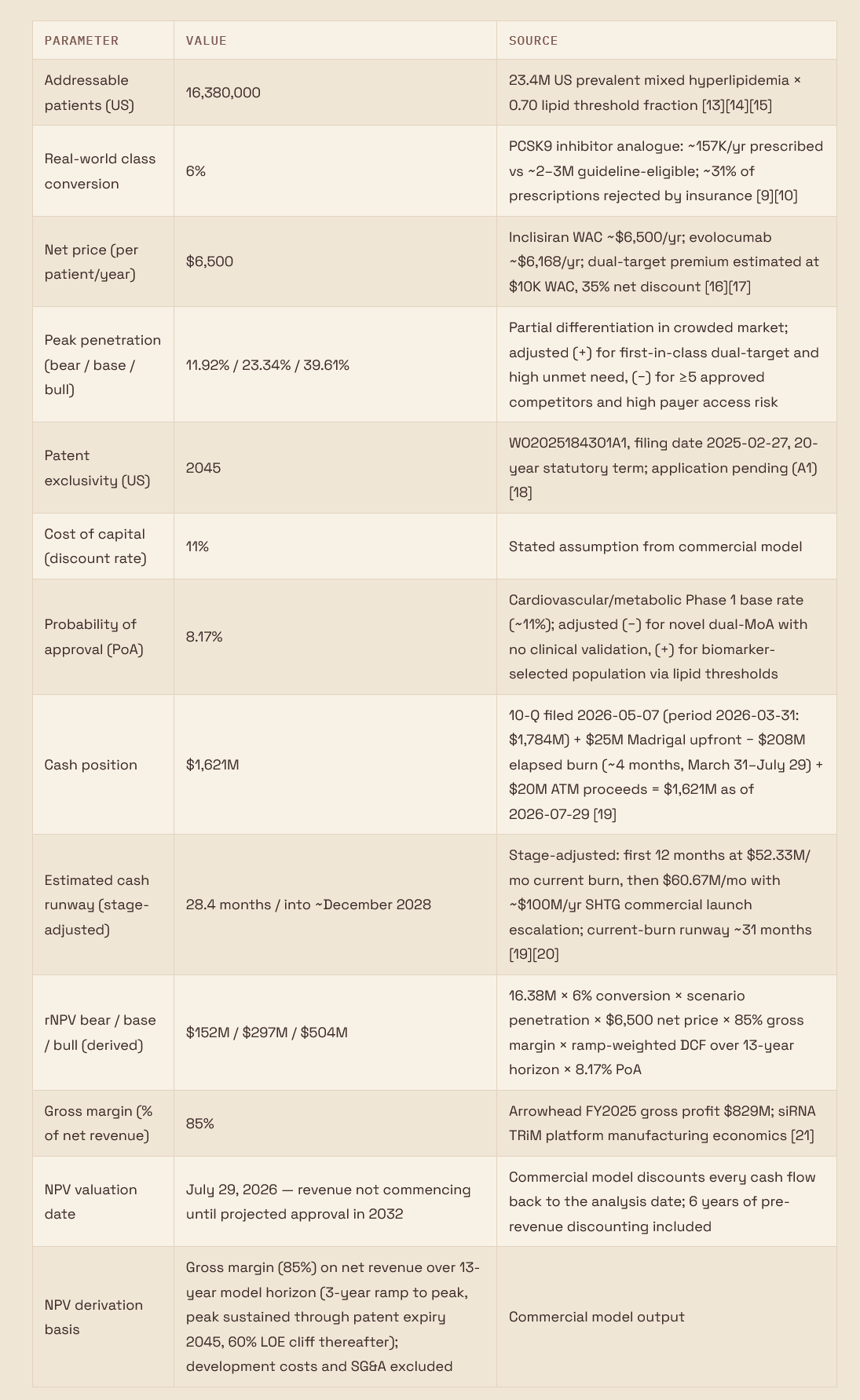
Declared Assumptions
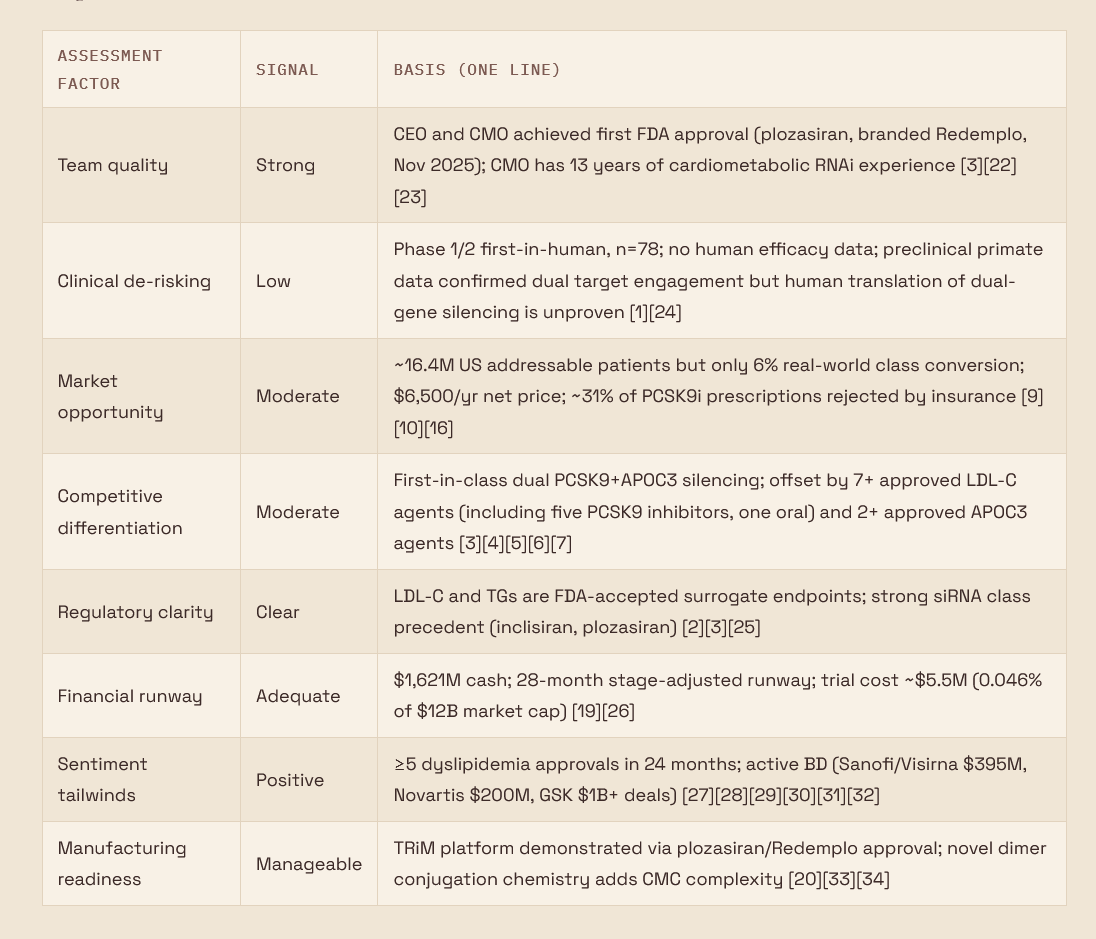
Program Scorecard
Risk-Adjusted Program Value:
Probability of Approval (PoA): 8.17% — reflecting a Phase 1 cardiovascular/metabolic base rate adjusted (−) for the novel dual-MoA with no clinical validation, (+) for biomarker-selected population
rNPV base case: $297M — reflects present value as of July 29, 2026; underlying revenue does not begin until projected 2032 approval; US-only model under current label scope
Peak revenue base case: $1,491M in year 4 post-approval (~2036) — 23.34% penetration of 16.38M addressable patients × 6% real-world conversion × $6,500 net price
Near-Term Catalysts
Catalyst 1: Phase 1/2 Safety and PD Biomarker Readout
Expected timing: Q3 2026 (trial completion September 30, 2026) [11]
Trial design context: Randomized, placebo-controlled dose-escalation in 78 adults with mixed hyperlipidemia; primary endpoint is TEAE incidence; secondary endpoints include percent change in LDL-C, TG, apoC-III, and PCSK9, providing the first human pharmacodynamic evidence of simultaneous dual-gene silencing [11][35]
Positive outcome: Trial demonstrates acceptable safety (discontinuation and G3/4 AE rates within class-expected ranges of ~5% and ~4%) with meaningful dose-dependent reductions in serum PCSK9, apoC-III, LDL-C, and TGs — confirming dual-gene silencing is pharmacologically active in humans and supporting advancement to Phase 2b.
Negative outcome: Trial shows dose-limiting toxicity, unexpected hepatic signals from dual-gene silencing, or insufficient PD knockdown of either PCSK9 or APOC3 — raising doubt about whether the dimer construct achieves effective silencing of both targets simultaneously
Probability of positive outcome: ~55–60% — class safety profile is favorable (inclisiran 3.2% discontinuation, plozasiran zero treatment-related discontinuations) but dual-target novelty introduces unquantifiable risk [36][37][38][39]
Program impact: Binary/Pivotal
Catalyst 2: End-of-Phase 1 Regulatory Meeting (FDA Type B)
Expected timing: Q4 2026–Q1 2027 (following Phase 1/2 completion)
Positive outcome: FDA aligns on Phase 2 endpoint strategy (LDL-C and/or TG percent change as primary), dose selection, and patient population; Fast Track designation granted given serious condition and unmet need in mixed hyperlipidemia
Negative outcome: FDA requests additional nonclinical or clinical data before Phase 2 initiation, or raises concerns about the dual-mechanism endpoint strategy requiring separate demonstration of each target’s contribution
Probability of positive outcome: ~65% — LDL-C and TG are well-established surrogate endpoints with strong siRNA class precedent [25][40]
Program impact: De-risking
Catalyst 3: Phase 2b Initiation
Expected timing: 2027–2028 (contingent on Phase 1/2 readout and EOP1 meeting)
Positive outcome: Phase 2b trial initiates on schedule with a dose supported by Phase 1/2 PD data, enrolling mixed hyperlipidemia patients with established lipid thresholds
Negative outcome: Phase 2b delayed or redesigned due to insufficient Phase 1/2 dose-response signal, regulatory feedback requiring additional studies, or reprioritization within Arrowhead’s 16-program pipeline
Probability of positive outcome: ~45% — a conditional probability given that both prior gates (Catalyst 1 at ~55–60% and Catalyst 2 at ~65%) have already succeeded; the unconditional probability of reaching Phase 2b from today’s standpoint would be the product of all three probabilities (~16–18%); pipeline competition for resources within Arrowhead’s 16-program portfolio is an additional factor [41]
Program impact: Binary/Pivotal
Market Opportunity
The US addressable population for ARO-DIMERPA is approximately 16.4 million patients with mixed hyperlipidemia meeting elevated TG, LDL-C, and non-HDL-C thresholds, derived from ~23.4 million US prevalent mixed hyperlipidemia cases filtered by a 70% lipid-threshold fraction [13][14][15]. This is a broadly prescribed primary-care and specialist population, not a rare disease niche. However, real-world prescribing friction is severe: PCSK9 inhibitor analogue data show only ~6% of guideline-eligible patients are actually prescribed injectable lipid-lowering therapy, with ~31% of prescriptions rejected by insurance [9][10]. ARO-DIMERPA would face the same prior-authorization and payer friction barriers.
Pricing is anchored to inclisiran (~$6,500/year WAC) and evolocumab (~$6,168/year after a 60% price cut) [16][17]. A dual-target premium is estimated at $10,000/year WAC, with a 35% net discount yielding ~$6,500/year net price — comparable to inclisiran rather than commanding a meaningful premium, reflecting the crowded competitive landscape. Peak revenue ranges from $761M (bear) to $1,491M (base) to $2,530M (bull) at year 4 post-approval (~2036), reflecting penetration of 11.9% / 23.3% / 39.6% of the realistically treated pool (addressable × 6% conversion).
Class-level efficacy benchmarks contextualize ARO-DIMERPA’s competitive positioning. Inclisiran (PCSK9 siRNA) achieves 28–53% LDL-C reduction in ORION-1 [42], while plozasiran (APOC3 siRNA) demonstrates 50–62% TG reduction in the MUIR Phase 2 trial in mixed hyperlipidemia [39]. ARO-DIMERPA’s dual-target design would need to approach both benchmarks simultaneously to justify its positioning over separate single-target agents — a higher efficacy bar than either drug faces individually. Meanwhile, VERVE-102 (PCSK9 gene editing) has shown up to 62% LDL-C reduction with 18-month durability from a single dose [12], representing a potential paradigm shift in dosing convenience that could further compress ARO-DIMERPA’s differentiation window by the time it reaches the market, if durability and safety are confirmed in later-stage trials.
These headline figures are US-only under the current label scope (mixed hyperlipidemia with elevated lipids as add-on to statin therapy). Two independent upside levers exist: (1) label/patient-pool expansion — a cardiovascular outcomes indication (ASCVD event reduction) would broaden the eligible population by ~40%, requiring a dedicated Phase 3/4 CVOT with earliest plausible timeline ~2035–2037; and (2) ex-US revenue — EU5 + Japan at ~2.0× US patient volume with ~50% of US net pricing would add up to 100% upside. Combined, these levers multiply to 2.8× the base case (180% total upside), though ex-US pricing and penetration are typically lower than US and the stated upside is a ceiling under same-rate assumptions rather than a point estimate.
The competitive landscape is intensely crowded. Seven or more approved LDL-C-lowering agents exist, including five PCSK9 inhibitors (evolocumab, alirocumab, inclisiran, enlicitide [oral, approved July 2026], lerodalcibep) [4][5][6][8]. Two APOC3-targeting agents are approved for rare hypertriglyceridemia indications — plozasiran for familial chylomicronemia syndrome (FCS) and olezarsen for FCS and severe hypertriglyceridemia (SHTG) [3][7] — neither of which is currently approved for the broad mixed hyperlipidemia population that ARO-DIMERPA targets. Key pipeline threats include obicetrapib (CETP inhibitor, Phase 3, RECRUITING, EMA decision expected 2H 2026) [43][44], VERVE-102 (PCSK9 gene editing, Phase 1b/2, up to 62% LDL-C reduction with 18-month durability from a single dose) [12][45], and Arrowhead’s own zodasiran (ANGPTL3 siRNA, Phase 3) [46][47]. Evolocumab biosimilars are already approved, with PCSK9 mAb composition-of-matter patents expiring 2026–2028, creating significant price pressure [48]. By ARO-DIMERPA’s projected approval window (~2030–2032), based on currently disclosed pipelines, the landscape is expected to include oral, injectable, and gene-editing options across PCSK9, APOC3, ANGPTL3, and CETP pathways.
Management Team Assessment
CEO Christopher Anzalone has led Arrowhead for 18+ years through the TRiM platform’s maturation to commercial stage, achieving the company’s first FDA approval with plozasiran (Redemplo) in November 2025 [3][49][22]. CMO James Hamilton has 13 years of direct cardiometabolic RNAi clinical development experience at Arrowhead, including leadership of the plozasiran program that is directly adjacent to ARO-DIMERPA’s dual PCSK9+APOC3 mechanism [23]. This represents strong team–indication fit: the same leadership that brought an APOC3 siRNA through FDA approval is now developing a molecule that silences APOC3 alongside PCSK9.
The board is 85.7% independent (6 of 7 members), including a former Novartis CSO and a J&J commercial executive, providing relevant pharmaceutical industry experience [50]. However, the CEO also serves as Board Chair, a combined role that weakens governance oversight. The CFO, Daniel Apel, was appointed May 2025 from Walgreens/Bayer with no prior biotech CFO experience — a transition occurring during Arrowhead’s shift from development-stage to commercial-stage company [51].
Insiders recorded six open-market sales by three insiders (CMO Hamilton, CFO Apel, Director Lu) totaling ~$2.55M between March and May 2026, all under prescheduled 10b5-1 trading plans [52]. The CMO was the largest aggregate seller (~$1.39M across two transactions). Sales clustered shortly after the January 2026 $700M capital raise [53] while the stock traded $64–77 [52]. The aggregate value is modest relative to the company's $12B market cap [26], and the use of 10b5-1 plans across all transactions is consistent with pre-planned diversification rather than discretionary selling. Multiple non-dilutive partnerships with large pharma demonstrate disciplined capital management and platform validation, including Amgen (olpasiran, 2016) [54], Takeda (ARO-AAT, 2020) [55], Janssen (ARO-HBV, 2018, since wound down) [56][57], and GSK (ARO-HSD, NASH) [32]. Separately, Sanofi’s $395M plozasiran Greater China transaction was conducted through Visirna Therapeutics, Arrowhead’s majority-owned China subsidiary formed with Vivo Capital in 2022, rather than as a direct Arrowhead-Sanofi partnership [30][58].
Key Program Risks
Risk 1: Dual-gene silencing mechanism untested in humans
Category: Clinical
Probability: High
Program impact: Program-ending
Mitigation: Strong class-level safety data from inclisiran (PCSK9 siRNA) and plozasiran (APOC3 siRNA) on the same or related platforms; preclinical primate data confirmed dual target engagement [36][1][24][37][38][39]
Basis: ARO-DIMERPA is the first clinical candidate to covalently link two siRNA triggers in a single molecule; no human safety or efficacy data exist; additive or unforeseen hepatic effects from simultaneous PCSK9+APOC3 silencing cannot be excluded from single-target analogues [11][1][34]
Risk 2: Extreme market fragmentation and payer access barriers
Category: Commercial
Probability: High
Program impact: Major setback
Mitigation: First-in-class dual-target convenience (one injection vs. combining inclisiran + plozasiran) may differentiate on polypharmacy reduction; Arrowhead has commercial infrastructure via Redemplo launch [20]
Basis: Seven-plus approved LDL-C agents including a new oral PCSK9 inhibitor (enlicitide); two approved APOC3 agents (for rare FCS/SHTG indications); PCSK9 mAb biosimilars on market; real-world class conversion only 6% of eligible patients; ~31% of PCSK9i prescriptions rejected by insurance; high payer access risk in crowded cardiometabolic market [3][4][5][6][48][7][8][9][10]
Risk 3: No pre-specified Phase 2 go/no-go criteria
Category: Clinical
Probability: Medium
Program impact: Major setback
Mitigation: PD endpoints (serum PCSK9, apoC-III) are included as secondary measures and will provide direct target engagement data; class analogue benchmarks (inclisiran 28–53% LDL-C reduction, plozasiran 50–62% TG reduction) can anchor informal thresholds [42][39]
Basis: No quantitative go/no-go thresholds for Phase 2 advancement are documented in the available protocol; the dose-escalation design implies dose-finding but without pre-specified efficacy or PD thresholds, the Phase 2 decision will be judgment-based [35]
Risk 4: Novel dimer conjugation chemistry CMC risk
Category: Manufacturing
Probability: Medium
Program impact: Manageable
Mitigation: Arrowhead’s TRiM platform demonstrated commercial-scale siRNA manufacturing through plozasiran/Redemplo approval; Phase 1/2 requires only modest clinical supply quantities [20][33]
Basis: First-in-class dual-siRNA dimer construct has no clinical CMC precedent; novel conjugation chemistry requires additional process characterization; Arrowhead relies entirely on third-party CMOs with single-source suppliers for some components; no public stability data for ARO-DIMERPA [59][60][34]
Valuation Framework
The risk-adjusted NPV ranges from $152M (bear) to $297M (base) to $504M (bull), all reflecting present value as of July 29, 2026, with revenue not commencing until projected 2032 approval. The base-case rNPV of $297M is derived from a $3,634M NPV (gross margin on net revenue over a 13-year model horizon: 3-year ramp to peak, peak sustained through patent expiry in 2045, 60% LOE cliff thereafter) multiplied by the 8.17% probability of approval. Peak revenue ranges from $761M to $2,530M depending on penetration of the realistically treated patient pool.
The two assumptions driving most of the rNPV variance are: (1) probability of approval — at 8.17%, reflecting the early Phase 1/2 stage and unprecedented dual-mechanism novelty, this single multiplier compresses a $3.6B NPV to under $300M; and (2) real-world class conversion — at only 6%, this reflects the severe prescribing and payer friction that limits injectable lipid therapies despite large eligible populations [9][10]. Because both PoA and conversion enter the rNPV calculation as linear multipliers (rNPV = NPV × PoA, and NPV scales linearly with conversion), a doubling of either assumption would roughly double rNPV, underscoring how sensitive the valuation is to these two inputs.
Sensitivity Analysis — Base-Case rNPV Under Varied Key Assumptions
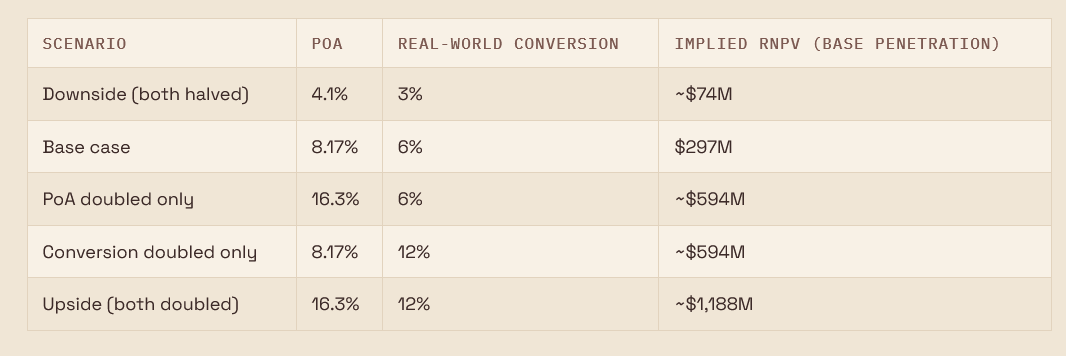
The symmetry of the table reflects the linear structure of the model: rNPV scales proportionally with both PoA and conversion independently, so the two levers are interchangeable in their marginal impact. In practice, PoA is the harder lever to move — it depends on clinical outcomes that are binary at the Phase 1/2 readout — while conversion could improve over time with broader payer coverage, guideline integration, or a more convenient dual-target dosing profile that reduces polypharmacy. The base-case 6% conversion is anchored to PCSK9 inhibitor analogue data from 2019–2021 [9]; the 2026 ACC/AHA dyslipidemia guideline [29] and the recent wave of PCSK9 approvals may modestly improve access over the model horizon, but the ~31% insurance rejection rate [10] suggests structural barriers persist.
Arrowhead’s partnership and licensing track record provides a relevant valuation reference. The Sanofi-Visirna deal for plozasiran Greater China rights was valued at $395M ($130M upfront + $265M milestones) [30], and the GSK-Arrowhead ARO-HSD deal reached $1B+ ($120M upfront + ~$910M milestones) [32]. A partnership/licensing value of ~$300M for ARO-DIMERPA is broadly consistent with the plozasiran Greater China deal — though ARO-DIMERPA is earlier-stage (Phase 1/2 vs. approved) and targets a more crowded indication. The estimated remaining cost to the next value-inflecting readout (Phase 1/2 completion) is only ~$5.5M [19], meaning the incremental cost to resolve the primary binary uncertainty is small relative to the potential partnership value a positive readout could unlock. The most significant value step occurs at the Phase 1/2 PD biomarker readout in Q3 2026: confirmation of dose-dependent dual target engagement (PCSK9 and apoC-III knockdown) with commensurate LDL-C and TG reductions would transform the program from preclinical-only evidence to human proof-of-concept, potentially enabling Phase 2 initiation and partnership discussions, though any valuation uplift would depend on the magnitude and durability of the pharmacodynamic signal observed.
Due Diligence Checklist
Confirm Phase 1/2 dose-escalation safety stopping rules and DLT definitions — Request the full clinical trial protocol from Arrowhead or ClinicalTrials.gov to verify pre-specified dose-limiting toxicity criteria, sentinel dosing periods, and safety review intervals between cohorts, which are absent from the publicly available protocol summary and are essential for assessing first-in-human risk management [35].
Obtain specific fasting TG, LDL-C, and non-HDL-C screening thresholds — Contact the sponsor or review the full protocol to confirm the exact lipid cutoff values used for enrollment, as these are not published and directly determine both trial eligibility and the likely commercial label population size [35].
Verify ARO-DIMERPA-specific patent status and US national-phase filing — Check USPTO and WIPO records for any granted US national-phase patent arising from WO2025184301A1, as the composition-of-matter application is currently pending (A1 status) and the 2045 expiry estimate is provisional [18].
Confirm Arrowhead’s Phase 2 development plans and timeline for ARO-DIMERPA — Review Arrowhead’s next quarterly earnings call or investor presentation for any disclosed Phase 2b trial design, timeline, or prioritization relative to the company’s 16 active programs, as pipeline resource allocation could delay advancement [41].
Track obicetrapib EMA decision (expected 2H 2026) and FDA filing status — Monitor NewAmsterdam Pharma regulatory announcements, as obicetrapib approval would add an oral CETP inhibitor to the competitive landscape before ARO-DIMERPA reaches Phase 2 [43][44].
Key Sources
[1] Arrowhead Pharmaceuticals Initiates Phase 1/2a Study of ARO-DIMER-PA. https://ir.arrowheadpharma.com/news-releases/news-release-details/arrowhead-pharmaceuticals-initiates-phase-12a-study-aro-dimer-pa.
[2] Inclisiran NDA 214012 Summary Review — FDA. https://www.accessdata.fda.gov/drugsatfda_docs/nda/2022/214012Orig1s000SumR.pdf.
[3] FDA Approves Redemplo (plozasiran) for Familial Chylomicronemia Syndrome — FDA.gov. https://www.fda.gov/drugs/news-events-human-drugs/fda-approves-drug-reduce-triglycerides-adults-familial-chylomicronemia-syndrome.
[4] Merck’s LIPFENDRA (enlicitide) — First Oral PCSK9 Inhibitor FDA Approved. https://www.merck.com/news/mercks-lipfendra-enlicitide-is-the-first-and-only-once-daily-oral-pcsk9-inhibitor-approved-by-the-u-s-fda-to-reduce-ldl-c-in-adults-with-hypercholesterolemia/.
[5] LIB Therapeutics Launches LEROCHOL (lerodalcibep) in the United States. https://libtherapeutics.com/news-and-events/lib-therapeutics-launches-lerochol-in-the-united-states-with-a-patient-first-approach-to-access-and-affordability.html.
[6] Novartis Leqvio (inclisiran) Receives FDA Approval for Monotherapy Use. https://www.novartis.com/us-en/news/media-releases/novartis-twice-yearly-leqvio-inclisiran-receives-fda-approval-new-indication-enabling-first-line-use.
[7] FDA Approves Olezarsen for Severe Hypertriglyceridemia. https://pace-cme.org/news/fda-approves-olezarsen-for-severe-hypertriglyceridemia/2487624/.
[8] FDA Approves Praluent (alirocumab) for Homozygous Familial Hypercholesterolemia. https://www.fda.gov/drugs/news-events-human-drugs/fda-approves-add-therapy-patients-genetic-form-severely-high-cholesterol.
[9] Trends in Patient Access to and Utilization of Prescribed PCSK9 Inhibitors. https://www.ahajournals.org/doi/10.1161/CIRCOUTCOMES.123.009988.
[10] PCSK9i Prescriptions Still Being Denied — Family Heart Foundation. https://familyheart.org/research-pcsk9i-still-being-denied.
[11] NCT07223658: Study of ARO-DIMERPA in Adult Participants With Mixed Hyperlipidemia. Arrowhead Pharmaceuticals. Phase 1/Phase 2. Status: RECRUITING.
[12] Lilly’s VERVE-102 PCSK9 Base Editor Phase 1b Heart-2 Results. https://www.prnewswire.com/news-releases/a-single-dose-of-lillys-pcsk9-base-editor-verve-102-reduced-pcsk9-by-up-to-88-and-ldl-c-by-up-to-62-with-durable-effects-supporting-its-potential-as-a-one-time-treatment-for-hypercholesterolemia-302780172.html.
[13] Hyperlipidemia - StatPearls. https://www.ncbi.nlm.nih.gov/books/NBK559182/.
[14] Distribution of lipid levels and prevalence of hyperlipidemia (NHANES 2007-2018). https://link.springer.com/article/10.1186/s12944-022-01721-y.
[15] Modern prevalence of Fredrickson-Levy-Lees dyslipidemias (Sathiyakumar et al. 2020). https://www.archivesofmedicalscience.com/Modern-prevalence-of-the-Fredrickson-Levy-Lees-r-ndyslipidemias-findings-from-the,110467,0,2.html.
[16] LEQVIO Savings & Insurance Information — Novartis. https://www.leqvio.com/savings-and-support/savings.
[17] Repatha (Evolocumab) Cost vs. Alternatives: Comparing PCSK9 Inhibitors. https://healthrx.com/evolocumab/cost-vs-alternatives.
[18] WO2025184301A1: RNAi agents for dual inhibition of expression of apolipoprotein c-iii (apoc3) and proprotein convertase subtilisin kexin 9 (pcsk9), compositions thereof, and methods of use. Assignee: Arrowhead Pharmaceuticals, Inc.. (priority 2024-02-29, filed 2025-02-27) https://patents.google.com/patent/WO2025184301A1/en.
[19] Arrowhead Pharmaceuticals Inc, 10-Q filed 2026-05-07, accession 0000879407-26-000047. https://www.sec.gov/Archives/edgar/data/879407/000087940726000047/arwr-20260331.htm.
[20] Arrowhead Pharmaceuticals Reports Fiscal 2026 Second Quarter Results. https://arrowheadpharma.com/en-us/newsroom/arrowhead-pharmaceuticals-reports-fiscal-2026-second-quarter.
[21] Arrowhead Pharmaceuticals Gross Profit 2012-2026 | ARWR. https://www.macrotrends.net/stocks/charts/ARWR/arrowhead-pharmaceuticals/gross-profit.
[22] Arrowhead Pharmaceuticals Announces FDA Approval of REDEMPLO (plozasiran) — Nov 18, 2025. https://ir.arrowheadpharma.com/news-releases/news-release-details/arrowhead-pharmaceuticals-announces-fda-approval-redemplor.
[23] James Hamilton, MD, MBA — Chief Medical Officer, Head of R&D, Arrowhead Pharmaceuticals. https://arrowheadpharma.com/en-us/about/leadership-team/james-hamilton.
[24] Arrowhead Pharmaceuticals Files CTA for Investigational ARO-DIMER-PA. https://ir.arrowheadpharma.com/news-releases/news-release-details/arrowhead-pharmaceuticals-files-cta-investigational-aro-dimer-pa.
[25] FDA Table of Surrogate Endpoints That Were the Basis of Drug Approval or Licensure. https://www.fda.gov/drugs/development-resources/table-surrogate-endpoints-were-basis-drug-approval-or-licensure.
[26] Arrowhead Pharmaceuticals Inc (ARWR) — Yahoo Finance. https://finance.yahoo.com/quote/ARWR/.
[27] FDA Approves Enlicitide, First Oral PCSK9 for High Cholesterol. https://www.ajmc.com/view/fda-approves-enlicitide-first-oral-pcsk9-for-high-cholesterol.
[28] Third-Generation PCSK9 Inhibitor Approved for High Cholesterol (lerodalcibep). https://www.medpagetoday.com/cardiology/dyslipidemia/119050.
[29] 2026 Guideline on the Management of Dyslipidemia — ACC/AHA. https://professional.heart.org/en/science-news/2026-guideline-on-the-management-of-dyslipidemia.
[30] Sanofi Purchases $130M Exclusive License for Plozasiran from Visirna Therapeutics. https://www.pharmexec.com/view/sanofi-purchases-130-million-license-plozasiran-visirna-therapeutics.
[31] Novartis Tries Again in Parkinson’s, Putting Up $200M for Arrowhead’s RNAi Therapy. https://medcitynews.com/2025/09/novartis-arrowhead-parkinsons-alpha-synuclein-sirna-rnai-nvs-arwr/.
[32] GSK dives into NASH, RNA interference with Arrowhead deal. https://www.biopharmadive.com/news/gsk-arrowhead-nash-rna-interference-deal/610485/.
[33] Arrowhead Pharmaceuticals Reports 2025 Fiscal Year-End Results. https://arrowheadpharma.com/en-us/newsroom/arrowhead-pharmaceuticals-reports-2025-fiscal-year-end-results.
[34] Inside TRiM: Arrowhead’s Modular RNAi Platform — Hepatic Dimer Platform description.

.
[35] NCT07223658 Study of ARO-DIMERPA in Adult Participants With Mixed Hyperlipidemia - CenterWatch. https://www.centerwatch.com/clinical-trials/listings/NCT07223658/study-of-aro-dimerpa-in-adult-participants-with-mixed-hyperlipidemia.
[36] Gaudet D et al.. Plozasiran (ARO-APOC3) for Severe Hypertriglyceridemia: The SHASTA-2 Randomized Clinical Trial. JAMA cardiology. 2024. PMID 38583092
[37] Two Phase 3 Trials of Inclisiran in Patients with Elevated LDL Cholesterol (ORION-10/11). https://www.nejm.org/doi/full/10.1056/NEJMoa1912387.
[38] Long-term efficacy and safety of inclisiran in patients with high cardiovascular risk (ORION-1 extension). https://www.thelancet.com/journals/landia/article/PIIS2213-8587(22)00353-9/fulltext.
[39] Arrowhead Pharmaceuticals Presents New Phase 2 Data of Plozasiran in Patients with Mixed Hyperlipidemia (MUIR). https://ir.arrowheadpharma.com/news-releases/news-release-details/arrowhead-pharmaceuticals-presents-new-phase-2-data-plozasiran.
[40] FDA-NIH BEST Resource: Validated Surrogate Endpoint — LDL Cholesterol. https://www.ncbi.nlm.nih.gov/books/NBK453484/.
[41] Arrowhead’s Pipeline and Timelines: A Snapshot from OnPoint.
.
[42] ORION-1: Inclisiran siRNA Phase 2 trial design and LDL-C reductions. https://www.acc.org/latest-in-cardiology/clinical-trials/2017/03/16/00/58/orion-1.
[43] NCT07219602: RUBENS: Obicetrapib/Ezetimibe in T2DM/Metabolic Syndrome. NewAmsterdam Pharma. Phase 3. Status: RECRUITING.
[44] NewAmsterdam Pharma Corporate Update — Obicetrapib Phase 3 Program. https://ir.newamsterdampharma.com/news-releases/news-release-details/newamsterdam-pharma-provides-corporate-update-and-reports-6.
[45] VERVE-102 (Verve Therapeutics, Inc.), PHASE1/PHASE2, mechanism: in vivo base editing therapy using adenine base editor (ABE) to permanently inactivate the PCSK9 gene in hepatocytes. [DB: verve-therapeutics-inc--verve-102] Sources: https://finance.yahoo.com/news/verve-therapeutics-announces-pipeline-progress-110000629.html, https://www.globenewswire.com/news-release/2025/01/13/3008312/0/en/verve-therapeutics-announces-pipeline-progress-and-anticipated-2025-milestones.html
[46] NCT07037771: Phase 3 Study of Zodasiran in HoFH (YOSEMITE). Arrowhead Pharmaceuticals. Phase 3. Status: RECRUITING.
[47] Arrowhead Completes Enrollment in Phase 3 YOSEMITE Study of Zodasiran for HoFH. https://ir.arrowheadpharma.com/news-releases/news-release-details/arrowhead-pharmaceuticals-completes-enrollment-global-phase-3.
[48] Repatha Patent Field & Generic Timeline: Biosimilar Entry. https://healthrx.com/evolocumab/patent-generic-timeline.
[49] Christopher Anzalone, PhD — Arrowhead Pharmaceuticals Leadership. https://arrowheadpharma.com/en-us/about/leadership-team/christopher-anzalone.
[50] Arrowhead Pharmaceuticals Inc, DEF 14A filed 2026-01-26, accession 0000879407-26-000019. https://www.sec.gov/Archives/edgar/data/879407/000087940726000019/.
[51] Arrowhead Pharmaceuticals Appoints Daniel Apel as Chief Financial Officer — May 13, 2025. https://www.biospace.com/press-releases/arrowhead-pharmaceuticals-appoints-daniel-apel-as-chief-financial-officer.
[52] Arrowhead Pharmaceuticals Inc, Form 4 filed 2026-01-29 to 2026-07-29, accession 0001830755-26-000007. https://www.sec.gov/Archives/edgar/data/879407/000183075526000007/.
[53] Arrowhead Pharmaceuticals Announces Proposed Offerings of Convertible Senior Notes and Common Stock — Jan 2026 ($700M). https://ir.arrowheadpharma.com/news-releases/news-release-details/arrowhead-pharmaceuticals-announces-proposed-offerings.
[54] Amgen and Arrowhead Pharmaceuticals Announce Two Cardiovascular Collaborations — Sept. 29, 2016. https://www.amgen.com/newsroom/press-releases/2016/09/amgen-and-arrowhead-pharmaceuticals-announce-two-cardiovascular-collaborations
[55] Takeda and Arrowhead Collaborate to Co-Develop and Co-Commercialize ARO-AAT for Alpha-1 Antitrypsin-Associated Liver Disease — Oct. 8, 2020. https://www.takeda.com/newsroom/newsreleases/2020/takeda-and-arrowhead-collaborate-to-co-develop-and-co-commercialize-aro-aat-foralpha-1-antitrypsin-associated-liver-disease/
[56] Arrowhead Enters $3.7 Billion License and Collaboration Agreements with Janssen — Oct. 4, 2018. https://arrowheadpharma.com/en-us/newsroom/arrowhead-enters-37-billion-license-and-collaboration-agreements
[57] Arrowhead’s $3.7B J&J deal is done, CEO says — Fierce Biotech. https://www.fiercebiotech.com/biotech/arrowheads-37b-deal-janssen-done-ceo-says-after-out-blue-nash-decision
[58] Arrowhead Pharmaceuticals and Vivo Capital Launch Joint Venture, Visirna Therapeutics — Apr. 25, 2022. https://arrowheadpharma.com/en-us/newsroom/arrowhead-pharmaceuticals-and-vivo-capital-launch-joint-venture
[59] Arrowhead Pharmaceuticals Form 10-K (FY2016) — limited manufacturing capability, third-party manufacturers. https://ir.arrowheadpharma.com/node/12241/html.
[60] Arrowhead Pharmaceuticals Form 10-K (FY2025) — single-source third-party suppliers for drug delivery devices. https://www.sec.gov/Archives/edgar/data/879407/000087940725000029/arwr-20250930.htm.
Disclaimer
This report is for informational purposes only and does not constitute financial or investment advice, a recommendation to buy or sell any security, or a solicitation of any offer. The analysis is based on publicly available information and forward-looking assumptions that may prove incorrect. Clinical, regulatory, and commercial outcomes are inherently uncertain. Readers should conduct their own due diligence and consult qualified advisors before making any investment decision.